

Do not sweat the small things or things out of your control.
Benjamin Franklin as interpreted by Andreas A Landman
Everyone has their picture of tranquillity. Some see the sea, others a
babbling river, others a mountain, yet others a library.
Depending on one’s picture of tranquillity, one would have many possible
paths to that tranquillity.
For Benjamin Franklin, it seems, tranquillity was related to focusing on
what he could control and not fretting about what he could not control. Not
fretting sounds tranquil – even if I am far too often sucked into worrying
about what I cannot control.
Our question is whether we can connect the virtue of tranquillity to the
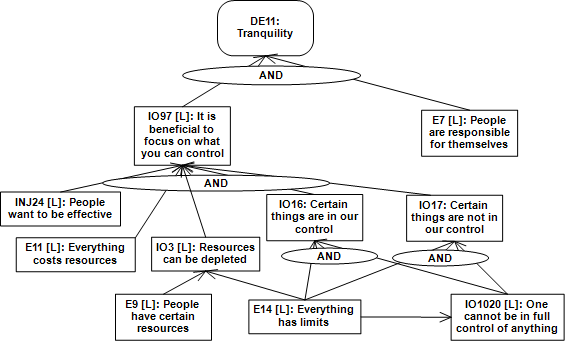
proposed fundamental principles of human effectiveness. The cause-and-effect logic above shows us the link.
(I forego labelling the main steps in the hope that the other examples in my
posts are sufficient to guide you to follow the reasoning.)
Since everything has limits, we can also say that our control of things is
limited, even to the extent that we cannot fully control anything.
If we have limits, including limited control, it follows that there are
certain things we can control and others we cannot.
Further, our resources are limited, so our resources might be depleted if we
attempt to control more than we can. If we want to be effective, we must focus
on what we can control. If we actively focus on what we can control, we can
achieve Franklin’s interpretation of tranquillity.

 Green Octahedron Blogging