Benjamin Franklin Virtue: Industry

Do not waste time – keep busy with something useful, and don’t do what is unnecessary.

Benjamin Franklin as interpreted by Andreas A Landman
Photo by Pixabay on Pexels.com

Wait, there’s more. Today, I add yet another block to our list of block types. Today’s block describes a definition. We have already reached the conclusion that words matter. Words mean different things to different people, therefore, we must use specific definitions to understand the meaning of what we are saying. (Often, you’ll find that you did not know what you were saying either.)
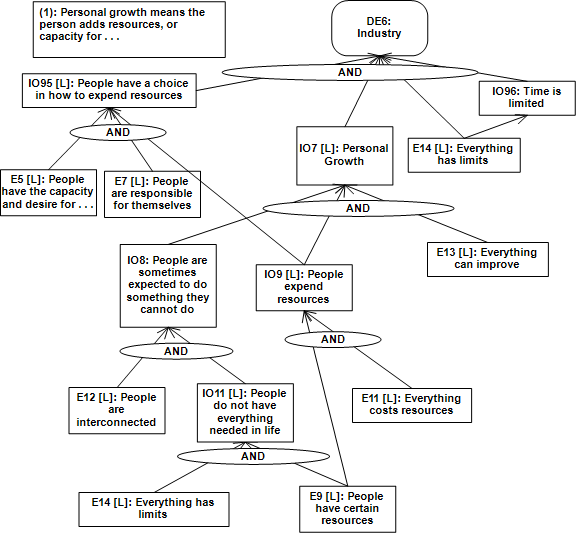
A: If everything has limits and people have certain resources, then people do always have everything needed in life.

A-B: If people are interconnected and do not have everything they need and people are interconnected, then people are sometimes expected to do something they cannot do.

C: If people have certain resources and everything costs resources, then people expend resources.

B and C – D: If people expend resources and everything can be improved, and people are sometimes expected to do something they cannot do, then people invest in personal growth.

C-E: If people expend resources and people have certain capacities and desires and people are responsible for themselves, then people have a choice in how to expend their resources.

D and E: If people have a choice in how to expend resources, and people invest in personal growth, and everything has limits (including time), then people should be industrious in doing something useful.

Benjamin Franklin Virtue: Order

Everything has a place and everything in its place. Everything has its time, and everything must be done in its time.

Benjamin Franklin interpreted by Andreas A Landman
Photo by cottonbro studio on Pexels.com

As I planned today’s blog, I realised I had introduced a new concept in the
previous discussions without bringing attention to it. I first mention my
oversight correctly to be true to the objective of being logically sound.

In the cause-and-effect diagram, we have several blocks, each with its
allocated meaning.

The fundamental principles are labelled with an E – indicating that they are
entities that exist, or so I say. Ideally, the lowest level of every
cause-and-effect diagram only contains E-blocks – the fundamental principles,
because they are, after all, fundamental.

The other block is the INJ block: people want to be effective. INJ is
another starting point block.

The IO blocks are intermediate objectives, which you have met before, which
allow us to build the logic step by step.

I did not mention before that the endpoint, the
virtue/value/habit/guideline, is a DE block. DE connotes Disirable Effect.

Today’s new block type is a UDE block. UDE connotes Undesirable effect.
These are also entry-level blocks indicating those aspects of life we do not
want, the aspects that effective people do not dare tolerate.

Today’s virtue is order and is close to my heart.

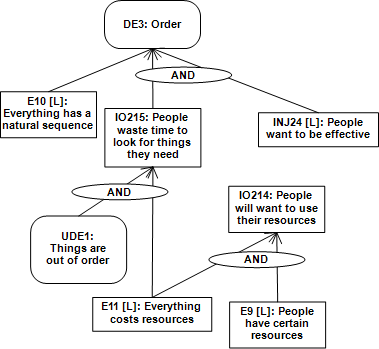
The fundamental principle that everything has a natural sequence leads
directly to the conclusion that there is order in time – everything has its
time.

However, putting things in their place flows more indirectly from the
fundamental principles.

A: If everything costs resources and people have certain resources, they
will want to use them.

A-B: If people want to use their resources and things are not in order (the
block of the day, the new block on the kid, the UDE, the undesirable effect)
and everything costs resources, then people waste time looking for things they
need.

B-DE: If people waste time looking for things they need and prefer to be
effective, they would rather have things/resources in their proper place –
ORDER.

I end with an obvious statement: If a thing is in its place, you will always
be able to find it!


Benjamin Franklin: Silence

Only say something that will benefit others or yourself; avoid trifling conversation

Benjamin Franklin (Interpreted by Andreas A Landman)
Photo by Mateusz Sau0142aciak on Pexels.com

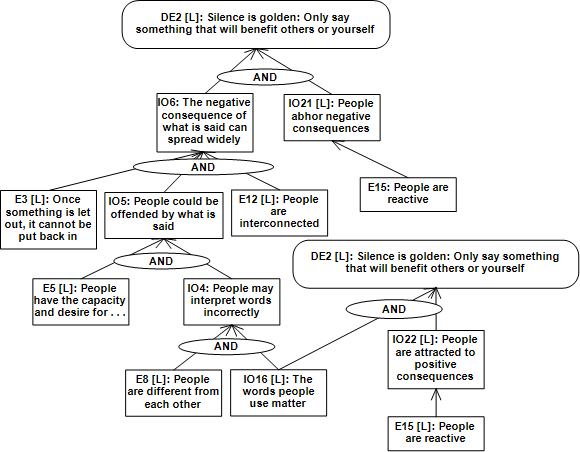
We previously concluded that words matter. We need not again deduce that intermediate objective to follow the reasoning to conclude that Silence is golden.

We reach the conclusion that Silence is Golden for positive and negative reasons.

The positive aspect of silence or well-chosen words is golden flows from the facts that words matter and that people are reactive – they like positive things.

The negative aspect of silence or well-chosen words is golden requires a few more logical steps.

A: If the words people use matter and people are different, then people may interpret the words used incorrectly.

A – B: If people may interpret the words differently and people have the desire to be loved, appreciated, understood, and valued, then people could be offended by what is said.

B – C: If people could be offended by what is said, and people are interconnected, and once something is said, it cannot be unsaid, then the negative consequences can spread widely.

C – Silence: If the negative consequence of what is said can spread widely and people want to avoid negative consequences, then silence is golden, or if you need to say something, only say something that benefits others or yourself.

Words Matter

Photo by mali maeder on Pexels.com

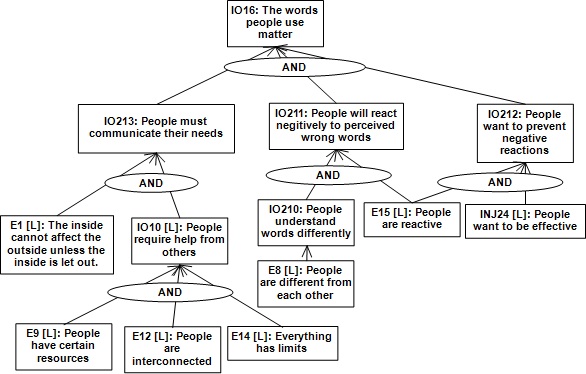
Before I continue with Benjamin Franklin’s virtues, I need an intermediate objective: Words matter.

We can conclude that words matter from at least two angles – the right words are required, and we want to avoid the wrong words.

[I have had valuable feedback – thank you. I will describe the logical connections better. I do not want you to be left with the erroneous idea that the if-then statements are all independent. The fundamental principles form the start of the logic and lead to the intermediate ideas/concepts/objectives (IO), with links between the intermediate objectives leading to the final statement.]

A) If people have other people as resources and people are interconnected and, everything has limits, then people require help from others.

A to B) If people require help from others and the inside cannot affect the outside unless the inside is let out, people must communicate their needs.

C) If people are different from each other, then people understand words differently. If people understand words differently and people are reactive, people will react negatively to perceived wrong words.

D) If people are reactive and people want to be effective (our global injections), people want to prevent negative reactions.

B+C+D) If people must communicate their needs and will react negatively to perceived wrong words, and want to prevent negative reactions, then words matter.

Benjamin Franklin’s Virtues and the Fundamental Principles

Seven Habits of Highly Effective People

Let us now test the usefulness of the fundamental principles by creating the chain of reasoning that links the fundamental principles to some of the principles mentioned in Dr Covey’s famous book.

Benjamin Franklin

Benjamin Franklin’s autobiography is the story of one man’s effort to integrate certain principles and habits deep within his nature. The Character Ethic taught that there are basic principles of effective living and that people can only experience true success and enduring happiness as they learn and integrate these principles into their basic character.

Dr Stephen R Covey

Benjamin Franklin refers to virtues, which I interpret to be values rather than principles. Today we look at self-restraint.

Self-restraint

Do not overeat nor drink until drunk.


Let’s read the sufficiency logic together. If People have certain resources, and everything costs resources and if everything has limits, then resources can be depleted. If everything has limits and everything as at least two significant sides, then everything can lose its benefit. If everything can lose its benefit and resources can be depleted and if everything has a natural sequence, then everything can potentially have negative consequences. If people are reactive then they abhor negative consequences (maybe this is a long arrow?). If people abhor negative consequences and everything can potentially have negative consequences and if people are responsible for themselves, then effective people show restraint.

Fundamental Principles underlying Drucker’s Eight Principles

Peter Drucker held that what made successful captains of industry effective is that they followed the same eight practices:

201 They asked, “What needs to be done?”

202 They asked, “What is right for the enterprise?”

203 They developed action plans.

204 They took responsibility for decisions.

205 They took responsibility for communicating.

206 They were focused on opportunities rather than problems.

207 They ran productive meetings.

208 They thought and said “we” rather than “I.”

The first two practices gave them the knowledge they needed. The next four helped them convert this knowledge into effective action. The last two ensured that the whole organization felt responsible and accountable.

Please note that Drucker refers to practices, not principles. Indeed a wise man.

Now we get to the practical expression of the fundamental principles. If the fundamental principles are sound and the practices of Drucker are indeed a sign of human effectiveness, then showing how the fundamental principles can be linked to the practices, will show the usefulness of the fundamental principles.

I will use a cause-and-effect diagram to link some of the fundamental principles to the Drucker Eight. I used Dettmer’s TransformationLogicTree software.

First, please note that these logical links are what are known as long arrows. Long arrows mean that the logic is not complete and that other links are missing. Another way of saying this is, it is false to say that the fundamental principle directly causes the practice. More is required.

For today’s blog it will suffice to express the long arrows.

The diagram is read: if the cause (bottom block) is present then the effect (top block) will also be present. This is sufficiency logic. For sufficiency logic, we need more detail because we often need more than one cause to ensure that the effect is present. We say that the one cause might be necessary but it is not sufficient to cause the effect.

But that is too much for one blog.

For today, please read the above diagram as If “People are interconnected”, then “They thought and said “we” rather than “I””. There might be something else required for this to be true and there definitely are assumptions underlying such a connection. That’s a lot to read into two boxes connected with an arrow, isn’t?

Fundamental Principle: People are Reactive

You might, for a moment, think that the fundamental principle that people are reactive is in direct opposition to the fundamental principle that people are responsible for themselves. Only for a moment though.

So we have:

People are reactive.

People are responsible for themselves.

These are not one, nor are the mutually exclusive. Nor are they two sides to the same issue. They are different, distinct and individually necessary to understand human effectiveness.

I cannot be an effective human being without being both reactive and responsible. I am responsible for my choice of reaction. If I do not react, that is choice of a reaction, and I will endure the consequences of that decision.

The fundamental principle that people are reactive supports what economists say, people react to incentives – they are attracted to positive reward and abhor negative consequences.

Fundamental Principle: Everything has limits

Photo by Greta Hoffman on Pexels.com

At first glance, you might not agree with the fundamental principle that everything as limits. Think about something, within the system of human effectiveness, that you think is limitless. Now, think of reasons you might be wrong?

Two things are infinite: the universe and human stupidity; and I’m not sure about the universe.

Elbert Einstein

Based on the fundamental principle that everything has limits, we can logically reach the following conclusions:

If everything has limits,

then every thing ends up having limits,

for example,

people can only focus on a small number of things at a time (ideally only one thing) because the brain has a limited amount of energy to spend on giving that focus.

Furthermore, focus leads to purpose, vision, commitment, and prioritisation – all valuable items in a model of human effectiveness.

Because one person can only focus on one thing, delegation is sometimes needed to give attention to more things – because more than one thing must be achieved at a time!

Renewal (continuous improvement) is needed because things are finite.

When something is renewed, it is new and no longer the old thing.

This supports the well-known golden goose analogy leading to the production-production capacity balance, which so many people ignore at their peril.

Taking this chain of thought further one reaches the conclusion that “treat your employees exactly as you want them to treat your best customers” is a worthwhile truism.

Fundamental Principle: Everything can improve

Photo by Maria Orlova on Pexels.com

The fundamental principle that everything can improve  might sound like wishful thinking, but without it being a valid principle, very little in human endeavour is of use.

Every situation can be substantially improved

Eliyahu M Goldratt and Efrat Goldratt-Ashlag

The principle leads to the conclusion that people are not fixed and can expand –the growth mindset. Remember the growth is possible because the outside was allowed to influence the inside. The person or system that grew is no longer the old system, it is an improved system with new potentials for growth, and so forth . . .

Fundamental Principle: Everything costs resources

Photo by Tima Miroshnichenko on Pexels.com

No such thing as a free lunch?

Really?

OK.

The fundamental principle that everything costs resources immediately leads to the fact that consequences are always present.

One cannot pick up one end of the stick without picking up the other end of the stick.

Dr SR Covey

Consequently, everything requires a proportional response. Why you ask? Maybe I can prevent you from asking why by saying that a proportional response includes thinking about responding and then deciding against outwardly doing something – which more often than not, takes a lot of resources.

Dr Frankl’s assertion that between stimulus and response, man has the freedom to choose follows from the fundamental principle.

Another truism flowing from this fundamental principle is that everything carries inherent risk and reward. The choice people make is which of the two (risk or reward) to heed more when making their decision.

The fact that no one is entitled to anything might sound negative but fits wholeheartedly into my view of life. This belief is deduced from the fundamental principle that everything costs resources AND does not preclude the intervention of a benefactor. When a benefactor plays a role in your life, you benefit because of their decision or resources, not because of some fundamental right you may feel to having that benefit. Now the cost is born by the benefactor, not you – but a cost is paid nonetheless.

Whether you act or not, you act. You might have been paralysed by the lack of data but the decision was always going to be made one way or another.

The consequences or resources consumed are not always predictable, what is predictable is that some form of payment is due. There are first order, second order and third order consequences. Likewise, there are intended and unintended consequences.