Don’t Turn a Health Crisis into an Economic Crisis

We must adapt and protect jobs.

brown and white bear plush toy
Photo by Pixabay on Pexels.com

In 2008 the world experienced an economic crisis.


In 2009 Dr Eliyahu Goldratt did a cause and effect analysis of the 2008 economic crisis. He concluded that our reactions transformed a financial crisis into an economic crisis.


In 2020, we face another economic crisis, initiated by our reaction to a health crisis. We do not learn from the past.


Some headlines illustrate my point:

Yes, it is worse than the flu: busting the coronavirus myths

Timeline of a virus

11 Myths about COVID-19 in South Africa


Coronavirus update: nations and companies react

Coronavirus will likely knock SA mining, tourism and telecoms – report

Five trends impacting SA’s apple and pear industries – and yes, the coronavirus is one

Israeli airline eyes mass job cuts over coronavirus

The Leader Of The Religious Sect That Spread Coronavirus In South Korea Says Sorry article contains a graph of the prevalence of COVID-19 which shows the expected trend for an outbreak of influenza.

South African tech stocks killed


Please, let us not change a health crisis (as bad as it is) into an economic crisis. We must think before we do.


We must think of retaining customers without delivering physical products. We must focus on the service offerings to wow the customers and maintain the relationship. The demand will still be there when the supply chain is restored.


We must plan to use the extra capacity in transport to ensure that we transport products as they become available – even in “uneconomical ways”.


We must adapt and protect jobs.

Unions are Entitled to be Consulted by the Business Rescue Practitioner

Unions are Entitled to be Consulted by the Business Rescue Practitioner

surfer rescue training
Photo by Guy Kawasaki on Pexels.com

News24 reported that Unions demand ‘meaningful engagement’ on SAA business rescue, or it’s back to court.

The unions are relying on the COMPANIES ACT 71 OF 2008 to demand “meaningful engagement”.

The companies act states the following section 144 part 3 d:

During a company’s business rescue process, every registered trade union representing any employees of the company, and any employee who is not so represented, is entitled to be consulted by the practitioner during the development of the business rescue plan, and afforded sufficient opportunity to review any such plan and prepare a submission.

Does the emphasis on “meaningful engagement” mean that there was engagement or not? Nevertheless, there is a clear indication that the unions are of the opinion that they will not be able to review and submit their view of the rescue plant before the shareholder approves the business rescue plan, as they are entitled to.

South African Unemployment Rate Highest Since the End of 2003

We should not take all values at face value but should dig a little deeper.

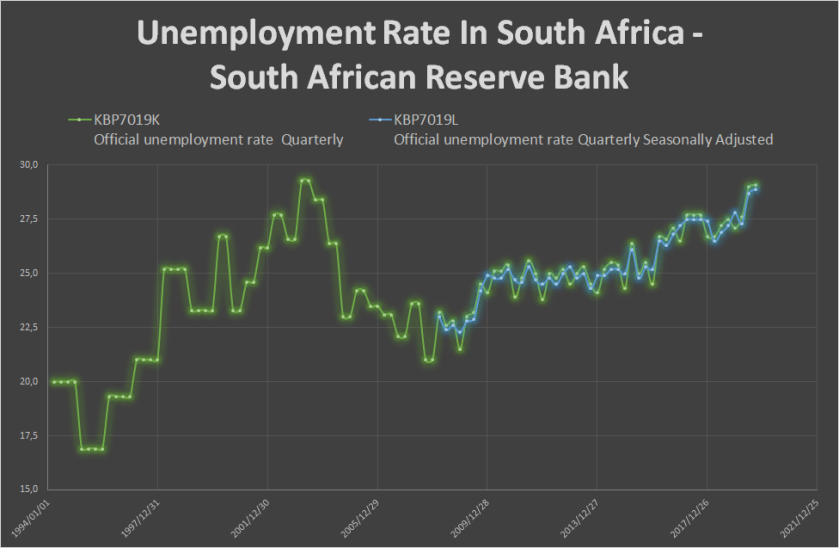
Unemployment.png

StatsSA recently released the latest South African Unemployment statistics. Many media reports took the results at face value. They reported that the latest figure, of 29,1 %, is the highest unemployment rate since 2008. I have not seen any media report stating the facts differently.

The reported unemployment statistic started in 2008 and is a seasonally adjusted figure. Hence, the reference date of 2008 is valid and misleading.

The South African Reserve Bank publishes the same figures (not yet updated). The SARB also shows the previously calculated Unemployment Statistic without seasonal adjustment. When looking at the non-adjusted unemployment statistic for South Africa, South Africa has reached the highest unemployment rate since quarter 4 of 2003.

We should not take all values at face value but should dig a little deeper.

The Ms Myeni Trial Shows the importance of the Separation of Powers

Corporate governance includes respecting the separation of power.

person sitting on green grass
Photo by Inactive. on Pexels.com

In this article, I highlight some of the issues of governance that receive mention in Ms Myeni’s trial. Robert Frost, in his poem “Mending Wall”, states that “Good fences make good neighbours.” The same is true for the separation of powers between shareholders, governing bodies and executive management.

The court heard of Myeni’s allegedly increasing interference with the running of the airline, as she shifted power away from the executive to the board.

She is also said to have changed the SAA supply chain management policy in 2016, to give the board sweeping power over procurement decisions.


“I can confirm that she (Myeni) was a non-executive. I can confirm that a non-executive member of the board never involves themselves in the executive decisions of the board. Even if the executive board is on its own, they are not allowed to involve themselves in the operational matters,” Rashaad Pandor of Rashad Attorneys told Fin24.


Former SAA interim CEO, Nico Bezuidenhout, on Monday detailed in court how the airline’s ex-chairperson, Dudu Myeni, interfered in the running of the flag carrier by issuing him with instructions to suspend or fire certain people.

A company’s Memorandum of Incorporation determines the role of the shareholders, governing body and the delegation to management. In general, the shareholders appoint the board, the board selects the Chief Executive Officer, who appoints the other executive team members as required.

According to King IV the “governing body assumes responsibility for providing the direction for how each governance area should be approached, addressed and conducted.

This is followed by formulation of policy in the form of frameworks, standards and plans by management to be approved by the governing body.

The governing body oversees and monitors implementation and execution by management,

and finally ensures that there is accountability for the performance in respect of each of these governance areas through reporting and disclosure.”

The governing body and executive managers have defined and separate duties. Corporate governance includes respecting the separation of power. Corporate governance leads to good performance and effective control.

Frightened of Becoming a Director?

So, when a headline frightens you, do a bit of research. You will find there is more protection for directors doing well than you thought.

group of people in dress suits
Photo by Marily Torres on Pexels.com
I learnt a lot of being a director from the Institute of Directors of South Africa, and I am a Certified Director.
Headlines like “Ziegler SA goes after SA Express board members in their personal capacity” can strike fear into the heart of anyone considering becoming a board member.
 
According to Section 76 of the COMPANIES ACT 71 OF 2008 directors must “must exercise the powers and perform the functions of director in good faith and for a proper purpose; in the best interests of the company; and with the degree of care, skill and diligence that may reasonably be expected of a person carrying out the same functions in relation to the company as those carried out by that director; and having the general knowledge, skill and experience of that director.”
 
Section 76 is difficult, and no one should take the role of director lightly. If directors do not follow section 76, they can be found liable.
 
The facts, as stated in the article, do not make it clear that the directors did not follow section 76. Thus, I find it unlikely that the court will find the board members liable.
 
Section 22 (Reckless Trading) of the companies act implies that Companies and Intellectual Property Commission may “issue a compliance notice to the company requiring it to cease carrying on its business or trading if the company is not able to pay its debts as they become due and payable in the normal course of business.” This is what Ziegler SA seems to be asking for.
 
The word delinquency is also mentioned in the article. A director can be found to be delinquent “when a director grossly abused the position of director; took personal advantage of information or an opportunity, intentionally, or by gross negligence, inflicted harm upon the company or a subsidiary of the company, acted in a manner that amounted to gross negligence, wilful misconduct or breach of trust in relation to the performance of the director’s functions within, and duties to, the company; has repeatedly been personally subject to a compliance notice or similar enforcement mechanism, for substantially similar conduct, in terms of any legislation.”
 
So, when a headline frightens you, do a bit of research. You will find there is more protection for directors doing well than you thought.

Long Serving Members of the Governing Body

Comair has taken the planned action to govern well.

adult blur boss business
Photo by energepic.com on Pexels.com

People build companies. People intend for companies to last a long time. Hence, people expect to stay with companies for a long time. What about members of the governing board?

The Comair board has received some attention in the news, lately:

https://www.fin24.com/Companies/TravelAndLeisure/comair-appoints-4-new-board-members-after-old-guard-exits-20200121

https://www.fin24.com/Companies/Industrial/our-board-is-not-compromised-comair-hits-back-as-more-directors-exit-20200109

https://www.fin24.com/Companies/Industrial/concerns-raised-about-long-tenure-of-comair-directors-20191105

The Comair AGM (29th of October 2019) resolved to amend the Memorandum of Incorporation to follow the recommendation of the King IV report, which reads as follows:

“A non-executive member of the governing body may continue to serve, in an independent capacity, for longer than nine years if, upon an assessment by the governing body conducted every year after nine years, it is concluded that the member exercises objective judgement and there is no interest, position, association or relationship which, when judged from the perspective of a reasonable and informed third party, is likely to influence unduly or cause bias in decision-making.”

The IoDSA published a “General Guidance Note on Board Composition” and discussed many of the issues that Comair is improving.


The Comair “Integrated Annual report 2019” follows many King IV recommendations. One missing disclosure, as recommended by King IV, is the member’s period of service on the governing body. (The aim is not to critique the Annual Report in its totality. Hence I don’t know all the deviations from King IV – nor should we expect 100 % compliance with the letter of King IV.)

The shareholders at the AGM elect board members. The annual report includes resolutions to re-elect several members.

Comair has taken the planned action to govern well. The shareholders have held the board accountable as is reasonable and proper.