
Everything has a place and everything in its place. Everything has its time, and everything must be done in its time.
Benjamin Franklin interpreted by Andreas A Landman
As I planned today’s blog, I realised I had introduced a new concept in the
previous discussions without bringing attention to it. I first mention my
oversight correctly to be true to the objective of being logically sound.
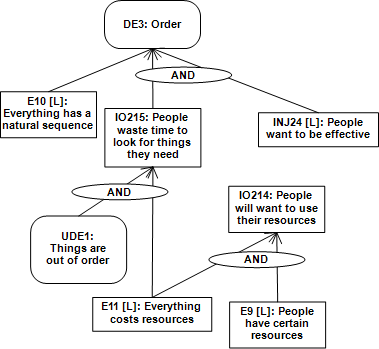
In the cause-and-effect diagram, we have several blocks, each with its
allocated meaning.
The fundamental principles are labelled with an E – indicating that they are
entities that exist, or so I say. Ideally, the lowest level of every
cause-and-effect diagram only contains E-blocks – the fundamental principles,
because they are, after all, fundamental.
The other block is the INJ block: people want to be effective. INJ is
another starting point block.
The IO blocks are intermediate objectives, which you have met before, which
allow us to build the logic step by step.
I did not mention before that the endpoint, the
virtue/value/habit/guideline, is a DE block. DE connotes Disirable Effect.
Today’s new block type is a UDE block. UDE connotes Undesirable effect.
These are also entry-level blocks indicating those aspects of life we do not
want, the aspects that effective people do not dare tolerate.
Today’s virtue is order and is close to my heart.
The fundamental principle that everything has a natural sequence leads
directly to the conclusion that there is order in time – everything has its
time.
However, putting things in their place flows more indirectly from the
fundamental principles.
A: If everything costs resources and people have certain resources, they
will want to use them.
A-B: If people want to use their resources and things are not in order (the
block of the day, the new block on the kid, the UDE, the undesirable effect)
and everything costs resources, then people waste time looking for things they
need.
B-DE: If people waste time looking for things they need and prefer to be
effective, they would rather have things/resources in their proper place –
ORDER.
I end with an obvious statement: If a thing is in its place, you will always
be able to find it!

 Green Octahedron Blogging