The reality of liquid in a bottle

Photo by Maria Orlova on Pexels.com

Today, I take a break from describing a specific fundamental principle of human effectiveness. I will take a step back and explain how I landed on some of the fundamental principles.

Like Altschuler I would like to start in the physical sciences with liquid contained in a bottle.

The liquid is in the bottle.

If the liquid is outside of the bottle, the liquid is not inside the bottle.

If the bottle contains soapy water, you cannot draw orange juice from the bottle.

If the bottle is not made to hold, say strong chemicals the bottle will deteriorate and might burst completely.

Once the liquid is outside of the bottle the liquid cannot be put back precisely as it was, the liquid, now exposed to the outside of the bottle, has picked up some contaminants.

The all-time favourite is that the liquid can only come out of the bottle if something else is let into the bottle. If the liquid is let out, without allowing air in, a vacuum is formed which will either stop the liquid from flowing out or will make the bottle collapse onto itself.

When the bottle is empty, it is empty. There is a finite amount of liquid in the bottle.

If you have water in the bottle and wish to make juice from a concentrated solution of the juice, the water will only become diluted juice if the concentrated juice is allowed into the bottle.

The above thinking gets me to the following fundamental principles of human effectiveness:

  1. The inside cannot affect the outside unless the inside is let out.
  2. The outside cannot affect the inside unless the outside is let in.
  3. Once something is let out, it cannot be put back in.
Crystal for a Christmas Tree – Science at work

The copper-iron and copper-silver interaction are examples of reduction and oxidation reactions.

#Christmas #Science #Chemistry

https://youtu.be/rplxY-THOQg


In the clip, a copper tree turns into a silver covered tree, which looks like a snow covered tree.


For those thinking of replicating the experiment, be prepared to fork out about $ 100.


You can do a much cheaper experiment (less than $ 1). Dip an iron nail into a copper sulphate solution. The iron nail will turn into a copper nail, almost immediately!


The copper-iron and copper-silver interaction are examples of reduction and oxidation reactions. Oxidation and reduction reactions make mirrors possible where silver is deposited on glass and copper is deposited on the silver layer.


Thanks for the link Alexander and Anderson.

Watching the Kettle Boil – Science

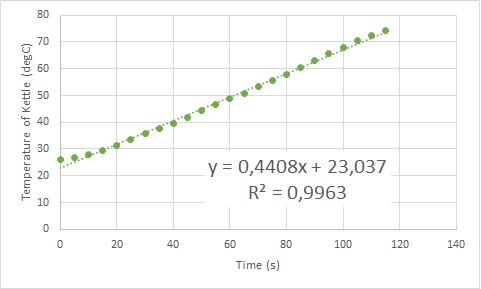
I used the time lapse facility to capture the image of the water heating process every five seconds and plotted the relationship. The relationship is linear, confirming that the 2000 W kettle element adds a constant amount of energy to the kettle and water every second.

#Science #ScienceatHome #FLIR #CatS61

img_20190110_084639
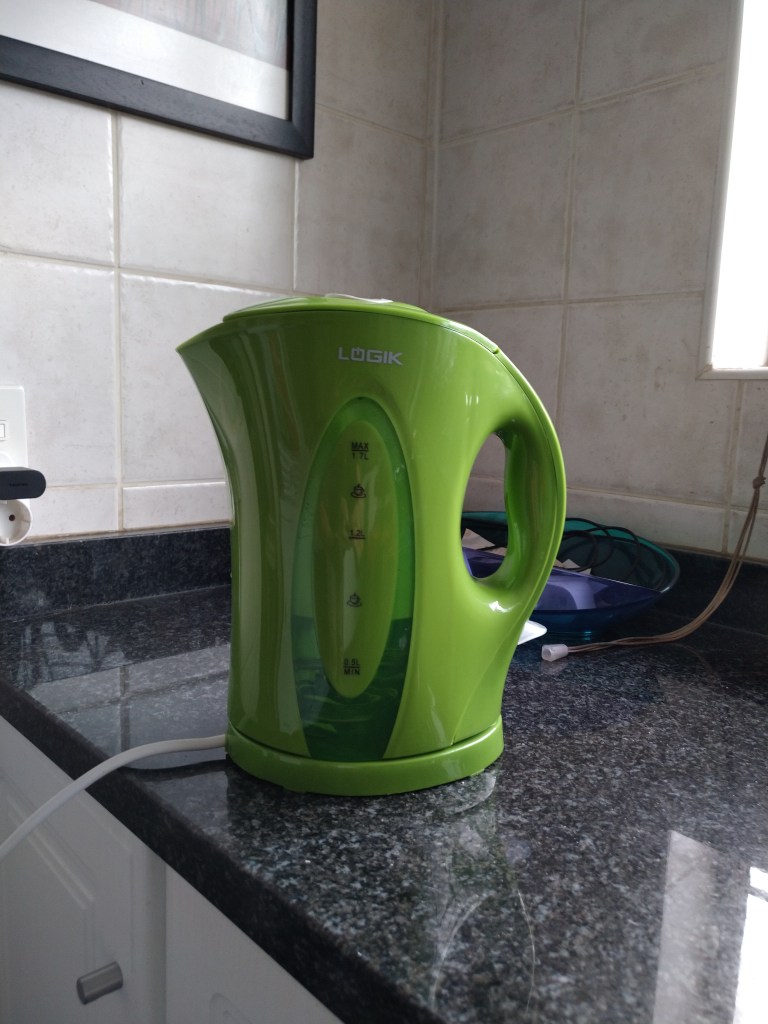
Yes, a GREEN Kettle – of course.

I am the proud owner of a CatS61 smartphone, with a FLIR camera. The smartphone does what I need it to do.
 
Science is about observing nature and, as a friend of mine commented, saying “That’s odd”. I add, “How does that work?”
The people around me need me to have my morning coffee. On the odd occasion, my mind is awake before the coffee, though. I took out my Cat S61 FLIR camera and took photos of the kettle boiling, and yes it is a green kettle.
The photos show the false colour images; showing the relative temperatures of the objects in the room. As the water boils, the kettle’s body also heats up, and the images represent what is happening to the water inside the kettle. The images show the inferred temperature at the cross-hair point.
I used the time lapse facility to capture the image of the water heating process every five seconds and plotted the relationship. The relationship is linear, confirming that the 2000 W kettle element adds a constant amount of energy to the kettle and water every second.

plot of temperature
Proving that energy is constantly added to the kettle and water converting electrical energy into thermal energy