Many others also mention Principles, but those “principles” do not fit with the concept Dr Covey shares – other authors refer to practices as principles. I have given the concept of principles some thought. The concept of a “principle”, it turns out, is not an easy one.
Looking at Product Management, Brandon Chu also approached this subject recently. Despite a valiant attempt, I think he fell short. This is my opinion and does not reflect on the value of the ideas he conveys, just that I disagree that the term principle is applicable to his writing.
Oxford Dictionary: “Principle – a fundamental truth or proposition that serves as the foundation for a system of belief or behaviour or for a chain of reasoning.” I attempt to display the words in the picture above.
From the definition I deduce that
Not all statements are principles.
Not all platitudes are principles.
Not all ideas/terms/sayings are principles.
Not all values are principles. Values flow from principles.
Furthermore, the name of the principle does not always say what the principle is. The principle requires an explanation, which allows one to build a link from the principle towards behaviour or understanding, and the consequences one can expect from violating or adhering to the principle.
Principles can only be defined within a certain context to build a system of belief regarding that context. The context is a system.
Principles, as far as Covey is concerned, are timeless, universal, self-evident and in operation whether we accept or understand them or not.
Dr Covey’s material deals with Human effectiveness in personal and work life.
Therefore, for principles in this context to be sensibly described, they must link the name of the principle to the values/beliefs/behaviour/habit of human effectiveness.
The context that I choose for principles is not chemistry, physics, or mathematics – if such principle were available.
I choose the context or system to be human effectiveness in personal and work life.
To soften the claim that most principles are not principles, I propose the use of the term “Fundamental Principle”.
The time has come to put together a working definition that will guide me through several posts:
Fundamental principles express what people are or have and serve as the foundation for a chain of reasoning to support human effectiveness.
Therefore, grammatically at least, a fundamental principle will not describe what people do. As an example, when someone claims that they are mentioning a fundamental principle, and describe a human action, they are indeed not discussing a fundamental principle.
Now I will go back and apply this definition to my thoughts before I share a list of fundamental principles and disagree with myself in public.
I have been thinking about the work environment with my mentor, Philip Viljoen. In this article, I show how the principles contained in the following books combine to form a winning culture:
Let’s start with some naming conventions. When our titles change, there are also significant changes in the way we think – we experience a paradigm shift. Do not believe me? See what happens when you use the wrong designation against someone’s name. Instead of employee and employer, I refer to Company People. Instead of “manager/employer” and “worker/employee/operator” we should refer to coaches and players. The assumption, of course, is that I am referring to good coaches and good players. Would a company not want good coaches and good players as company people?
The trust relationship between the company players and coaches must be in place before any meaningful engagement. For company people to have trust, they must work on their character and their competence. Character is built by transparency, respect, straight talk, righting wrongs, loyalty, extended trust and seeking first to understand then to be understood. When people think win-win, they can be both considerate and courageous. People who are both considerate and courageous can talk straight. Courageous people can right wrongs. Whereas, when people are considerate and feel appreciated, they feel respected. To make people feel appreciated company people must use the appropriate language of appreciation because some people feel appreciated when they receive words of affirmation, spend quality time with someone, benefit from acts of service, receive tangible gifts or when they are physically touched appropriately.
One way of extending trust is to form a stewardship agreement between the players and coaches. A stewardship agreement consists of clear expectations (born out of beginning with the end in mind and putting first things first), clear consequences, accountability, resource availability and guidelines on what is allowed and what is not allowed. The essence is that the player is held responsible for the results without being prescriptive on how the results are obtained unless specific methods are out of bounds. When the consequences are clear, the company people are self-disciplined. Keeping commitments also allows coaches to extend trust. Keeping commitments is the result of company people putting first things first and being proactive.
When company people get better at what they do and fulfil their stewardship agreements, they deliver meaningful results. Company people grow competence when seeking first to understand then to be understood, extending trust, delivering meaningful results and confronting reality.
Company players and coaches work in harmony when they improve their competence, work synergistically, and focus on global improvement. The harmonious relationship between players and coaches is also the result of company people understanding the rationale behind different decisions, having a high level of trust between coaches and players, and when company people have found their voice and inspire others to find theirs. In short, company people have public victories, meaning they have moved from independence to interdependence. Moving from independence to interdependence is the result of working synergistically. Working synergistically requires people to think win/win, seeking first to understand then to be understood and having private victories – moving from dependence to independence. The private victory is the result of people being proactive, putting first things first and beginning with the end in mind. All this only fed by sharpening the saw.
A clear common vision statement aligns the company people. A vision statement consists of a meaningful purpose, a picture of the future, a common understanding of the company’s ranked order values, and acknowledgement that principles govern. The description of the future incorporates the needs of the main stakeholders (owners, company people, customers, and suppliers) and the four human endowments (spiritual, mental, social/emotional, and economical). Goal alignment, role alignment and a shared understanding of company values lead to sensible procedures. Sensible company procedures, a focus on teaching and training and upgrading of knowledge, skills, processes, and infrastructure lead to the company building capacity.
While we are considering the winning company culture, we can also consider the fact that people want to live a full life. The PERMA model helps understand what gives people a full life. When company people make deposits in each other’s emotional bank account and have a meaningful purpose, the company people experience positive emotions. Having a meaningful purpose also cause the company people to be engaged and work synergistically. The result is that the company people deliver meaningful results, which cause them to experience well-being and happiness and thus live a full life. Living a full life, together with experiencing well-being and happiness, leads to the company people being motivated.
The TOC way of achieving meaningful results follows a different route. This route starts with the company people applying TOC thinking. Some of the basic tenets of TOC is that every situation is simple, every conflict can be removed, people think win/win, and every situation can be substantially improved. These four tenets cause people to think clearly. Thinking clearly and sharpening the saw give company people the stamina to overcome failures. Thinking clearly also leads to the belief that there are many opportunities to improve throughput and that company people can work synergistically. And these lead to people delivering meaningful results.
Many good initiatives fail in the execution phase – this does not have to be the case. Applying TOC thinking leads to a focus on global improvement, which means the team focuses on wildly important goals (WIG) with global impact. TOC thinking also implies managing according to throughput accounting practices, which takes operating expenses, investment, and throughput into account. Thus, company people use sensible global lead measures. To ensure successful execution, the company people track progress against lead measures on a sensible team scoreboard. Company people review the scoreboard in weekly meetings where the team holds each other accountable and make new commitments. The new commitments add to the company people clarifying expectations. Once the team starts influencing the lead measures, and the lead measures are predictive of meeting the wildly important goal, the company people deliver meaningful results.
For the company people to continue to be motivated, the company must have a sound performance management system. With the shared vision in place, the coaches coach, according to the agreed ranked value system. The shared vision also ensures that the company people use sensible global lead measures. The performance management system consists of performance planning, coaching and review. Performance planning consists of setting up one-minute goals based on the stewardship delegation/agreements. The coaching involves catching the company people doing things right and giving one-minute praising, redirection, or reprimands.
The coaching is also based on matching the coaches’ leadership styles with the development levels of the players. Company players with low competence and high commitment are coached with high direction and low support. Company players with high competence and high commitment are coached with low direction and low support. Company players with low competence and low commitment are coached with high direction and high support. Company players with high competence and variable commitment are coached with high direction and low support. Coaches show directive behaviour when they teach, observe, provide frequent feedback, and make decisions. Company coaches show supportive behaviour by listening, being involved, facilitating, and encouraging.
Thus, we have a motivated team of company people who are not demoralised by a lousy performance management system—yielding a winning Company.
Workplace discipline is often confused with punishment. The confusion is unnecessary. Workplace discipline protects the Employer and Employee by correcting inappropriate behaviour. Workplace discipline prevents damage.
The Employer can categorise “Inappropriate behaviour” misconduct or incapacity.
The incapacity process involves three (or more) discussions. These discussions focus on the gaps between the current and desired performance of the Employee. The outcomes of the discussions are definite plans to close the gaps in performance. The programs might include more training and coaching. If the employer-employee relationship cannot continue, the Employer must present the evidence to a disciplinary enquiry. The chairperson of the disciplinary enquiry might then give sanction of no-fault dismissal.
For a severe offence (misconduct) the procedure often includes
the evidence hearing,
the verdict hearing
and the sanction hearing.
The term hearing above is interchangeable with Disciplinary Enquiry.
Workplace discipline must be progressive. The Employer must be sure that the Employee knows what the Employer expects. Often, employers don’t follow progressive discipline. The Employer then “jumps” to the worst punishment as the first step. Steps for progressive discipline can include the following:
Training
Coaching
Retraining
Verbal warning
Recorded warning
Written warning
Final written warning
Dismissal.
A disciplinary enquiry is usually only held when the Employer expects a final written warning or dismissal.
The chairperson of the hearing, Employee and Employer must determe whether the following is true:
Is there a rule?
Is the rule known to the Employee?
Is the rule reasonable?
Is the rule applied consistently?
Is the sanction fair?
My latest book (I Keep Record of Disciplinary Enquiries) guides the chairperson of the enquiry, Employee and Employer through the disciplinary enquiry. This procedure should prevent procedural unfairness. The other test is substantial fairness. The chairperson can ensure substantial fairness by applying his or her mind and making a desicion on the balance of probability.
In 2009 Dr Eliyahu Goldratt did a cause and effect analysis of the 2008 economic crisis. He concluded that our reactions transformed a financial crisis into an economic crisis.
In 2020, we face another economic crisis, initiated by our reaction to a health crisis. We do not learn from the past.
Please, let us not change a health crisis (as bad as it is) into an economic crisis. We must think before we do.
We must think of retaining customers without delivering physical products. We must focus on the service offerings to wow the customers and maintain the relationship. The demand will still be there when the supply chain is restored.
We must plan to use the extra capacity in transport to ensure that we transport products as they become available – even in “uneconomical ways”.
The companies act states the following section 144 part 3 d:
During a company’s business rescue process, every registered trade union representing any employees of the company, and any employee who is not so represented, is entitled to be consulted by the practitioner during the development of the business rescue plan, and afforded sufficient opportunity to review any such plan and prepare a submission.
Does the emphasis on “meaningful engagement” mean that there was engagement or not? Nevertheless, there is a clear indication that the unions are of the opinion that they will not be able to review and submit their view of the rescue plant before the shareholder approves the business rescue plan, as they are entitled to.
We should not take all values at face value but should dig a little deeper.
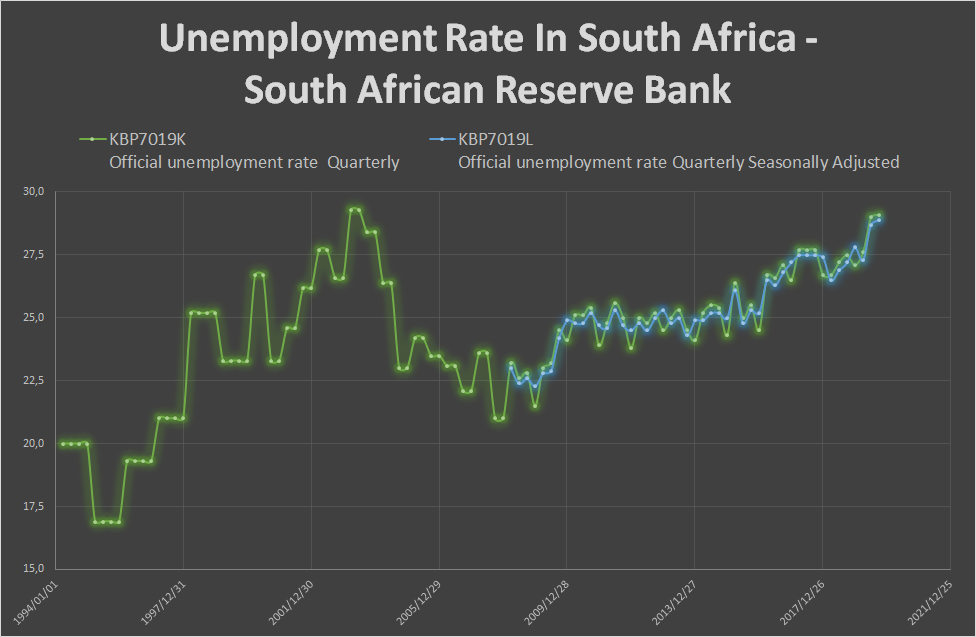
StatsSA recently released the latest South African Unemployment statistics. Many media reports took the results at face value. They reported that the latest figure, of 29,1 %, is the highest unemployment rate since 2008. I have not seen any media report stating the facts differently.
The reported unemployment statistic started in 2008 and is a seasonally adjusted figure. Hence, the reference date of 2008 is valid and misleading.
The South African Reserve Bank publishes the same figures (not yet updated). The SARB also shows the previously calculated Unemployment Statistic without seasonal adjustment. When looking at the non-adjusted unemployment statistic for South Africa, South Africa has reached the highest unemployment rate since quarter 4 of 2003.
We should not take all values at face value but should dig a little deeper.
Technology is not always the answer. One should use a tool as and when appropriate – horses for courses.
Many times we sit alone or within a group and we want to lay-out a project plan. We want to know whether we can or should do the project. Further, we also want to make sure we have a good base for more detailed planning with an advanced tool. The key is that we do not want to battle with the tool, we want to get the planning done.
One way of drawing up a first-pass project plan is to go old school and use pen and paper. A blank piece of paper is usually very daunting and can become chaotic.
Project planning involves deciding who needs to do what by when, and what comes first. Project management is much more, though.
In Gantt charts, you show “the what” in the first column and use several columns to show the when (from start to finish). The columns express different timeframes – depending on the extent of the project and the level of planning. Examples of timeframes are minutes, hours, days, months and years. You can plan the same project several times. You can plan at the level of months, then weeks. As the date of doing “the what” comes closer, you can plan hourly or even by the minute.
The tables in the book also allow you to show which tasks depend on each other.
According to Section 76 of the COMPANIES ACT 71 OF 2008 directors must “must exercise the powers and perform the functions of director in good faith and for a proper purpose; in the best interests of the company; and with the degree of care, skill and diligence that may reasonablybe expected of a person carrying out the same functions in relation to the company as those carried out by that director; and having the general knowledge, skill and experience of that director.”
Section 76 is difficult, and no one should take the role of director lightly. If directors do not follow section 76, they can be found liable.
The facts, as stated in the article, do not make it clear that the directors did not follow section 76. Thus, I find it unlikely that the court will find the board members liable.
Section 22 (Reckless Trading) of the companies act implies that Companies and Intellectual Property Commission may “issue a compliance notice to the company requiring it to cease carrying on its business or trading if the company is not able to pay its debts as they become due and payable in the normal course of business.” This is what Ziegler SA seems to be asking for.
The word delinquency is also mentioned in the article. A director can be found to be delinquent “when a director grossly abused the position of director; took personal advantage of information or an opportunity, intentionally, or by gross negligence, inflicted harm upon the company or a subsidiary of the company, acted in a manner that amounted to gross negligence, wilful misconduct or breach of trust in relation to the performance of the director’s functions within, and duties to, the company; has repeatedly been personally subject to a compliance notice or similar enforcement mechanism, for substantially similar conduct, in terms of any legislation.”
So, when a headline frightens you, do a bit of research. You will find there is more protection for directors doing well than you thought.
Walter Pauk‘s book, “How to Study in College”[1], describes a note-taking method; known as “the Cornell note-taking system”. Scott Mautz[2] adds to this three-page-golden-nugget in a 650-page book of golden nuggets, by suggesting that one also notes down action items and emotions solicited.
My book provides you with space for the Cornell note-taking system components of
Making notes during the lecture,
Summarising the ideas on the page of notes,
Writing questions to help you remember the recorded notes, and
Commenting on the emotions these notes elicit.
The example below shows you what a note page on a “lecture on the Cornell method” looks like.
Review Date:
2020/01/28
Continue from the previous page?
No
Date of Lecture:
2020/01/28
Topic of Lecture:
Cornell Note-taking method
Review questions:
Name four methods of notetaking
What are the four columns of the Cornell Note Taking method used for?
People build companies. People intend for companies to last a long time. Hence, people expect to stay with companies for a long time. What about members of the governing board?
The Comair board has received some attention in the news, lately:
The Comair AGM (29th of October 2019) resolved to amend the Memorandum of Incorporation to follow the recommendation of the King IV report, which reads as follows:
“A non-executive member of the governing body may continue to serve, in an independent capacity, for longer than nine years if, upon an assessment by the governing body conducted every year after nine years, it is concluded that the member exercises objective judgement and there is no interest, position, association or relationship which, when judged from the perspective of a reasonable and informed third party, is likely to influence unduly or cause bias in decision-making.”
The Comair “Integrated Annual report 2019” follows many King IV recommendations. One missing disclosure, as recommended by King IV, is the member’s period of service on the governing body. (The aim is not to critique the Annual Report in its totality. Hence I don’t know all the deviations from King IV – nor should we expect 100 % compliance with the letter of King IV.)
The shareholders at the AGM elect board members. The annual report includes resolutions to re-elect several members.
Comair has taken the planned action to govern well. The shareholders have held the board accountable as is reasonable and proper.












 Green Octahedron Blogging