Workplace discipline is often confused with punishment. The confusion is unnecessary. Workplace discipline protects the Employer and Employee by correcting inappropriate behaviour. Workplace discipline prevents damage.
The Employer can categorise “Inappropriate behaviour” misconduct or incapacity.
The incapacity process involves three (or more) discussions. These discussions focus on the gaps between the current and desired performance of the Employee. The outcomes of the discussions are definite plans to close the gaps in performance. The programs might include more training and coaching. If the employer-employee relationship cannot continue, the Employer must present the evidence to a disciplinary enquiry. The chairperson of the disciplinary enquiry might then give sanction of no-fault dismissal.
For a severe offence (misconduct) the procedure often includes
the evidence hearing,
the verdict hearing
and the sanction hearing.
The term hearing above is interchangeable with Disciplinary Enquiry.
Workplace discipline must be progressive. The Employer must be sure that the Employee knows what the Employer expects. Often, employers don’t follow progressive discipline. The Employer then “jumps” to the worst punishment as the first step. Steps for progressive discipline can include the following:
Training
Coaching
Retraining
Verbal warning
Recorded warning
Written warning
Final written warning
Dismissal.
A disciplinary enquiry is usually only held when the Employer expects a final written warning or dismissal.
The chairperson of the hearing, Employee and Employer must determe whether the following is true:
Is there a rule?
Is the rule known to the Employee?
Is the rule reasonable?
Is the rule applied consistently?
Is the sanction fair?
My latest book (I Keep Record of Disciplinary Enquiries) guides the chairperson of the enquiry, Employee and Employer through the disciplinary enquiry. This procedure should prevent procedural unfairness. The other test is substantial fairness. The chairperson can ensure substantial fairness by applying his or her mind and making a desicion on the balance of probability.

In 2009 Dr Eliyahu Goldratt did a cause and effect analysis of the 2008 economic crisis. He concluded that our reactions transformed a financial crisis into an economic crisis.
In 2020, we face another economic crisis, initiated by our reaction to a health crisis. We do not learn from the past.
Please, let us not change a health crisis (as bad as it is) into an economic crisis. We must think before we do.
We must think of retaining customers without delivering physical products. We must focus on the service offerings to wow the customers and maintain the relationship. The demand will still be there when the supply chain is restored.
We must plan to use the extra capacity in transport to ensure that we transport products as they become available – even in “uneconomical ways”.
The companies act states the following section 144 part 3 d:
During a company’s business rescue process, every registered trade union representing any employees of the company, and any employee who is not so represented, is entitled to be consulted by the practitioner during the development of the business rescue plan, and afforded sufficient opportunity to review any such plan and prepare a submission.
Does the emphasis on “meaningful engagement” mean that there was engagement or not? Nevertheless, there is a clear indication that the unions are of the opinion that they will not be able to review and submit their view of the rescue plant before the shareholder approves the business rescue plan, as they are entitled to.
We should not take all values at face value but should dig a little deeper.
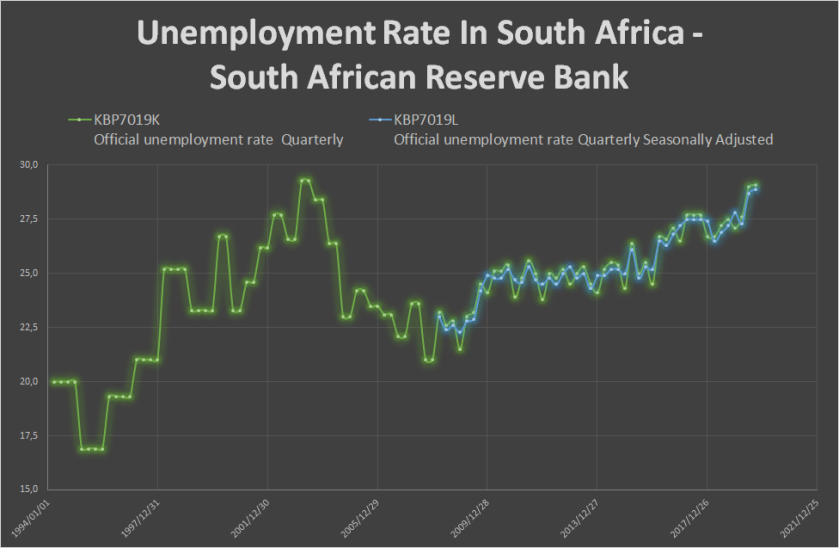
StatsSA recently released the latest South African Unemployment statistics. Many media reports took the results at face value. They reported that the latest figure, of 29,1 %, is the highest unemployment rate since 2008. I have not seen any media report stating the facts differently.
The reported unemployment statistic started in 2008 and is a seasonally adjusted figure. Hence, the reference date of 2008 is valid and misleading.
The South African Reserve Bank publishes the same figures (not yet updated). The SARB also shows the previously calculated Unemployment Statistic without seasonal adjustment. When looking at the non-adjusted unemployment statistic for South Africa, South Africa has reached the highest unemployment rate since quarter 4 of 2003.
We should not take all values at face value but should dig a little deeper.
Those who fail to plan, plan to fail – or so the poster in my primary school classroom said. Thus, Plan Weakly, is appropriate.
I have a book to help you keep track of your personal roles and the plans you make on for a week.
The pages of my book allow you to plan a week based on the roles you have identified for yourself and the goals you have set for yourself. The concepts expressed in those pages give life to the paradigms established by Stephen R Covey in his groundbreaking books:
The 7 habits of highly effective people
First Things First (with AR Merrill and RR Merrill)
Focus: Achieving your highest Priorities – The workshop to help you focus on and execute top priorities.
First, you write down your personal mission statement.
Second, you identify the roles you see yourself in. You also have the opportunity to plot out when you focus on each role.
Third, you identify goals for yourself in these roles.
Technology is not always the answer. One should use a tool as and when appropriate – horses for courses.
Many times we sit alone or within a group and we want to lay-out a project plan. We want to know whether we can or should do the project. Further, we also want to make sure we have a good base for more detailed planning with an advanced tool. The key is that we do not want to battle with the tool, we want to get the planning done.
One way of drawing up a first-pass project plan is to go old school and use pen and paper. A blank piece of paper is usually very daunting and can become chaotic.
Project planning involves deciding who needs to do what by when, and what comes first. Project management is much more, though.
In Gantt charts, you show “the what” in the first column and use several columns to show the when (from start to finish). The columns express different timeframes – depending on the extent of the project and the level of planning. Examples of timeframes are minutes, hours, days, months and years. You can plan the same project several times. You can plan at the level of months, then weeks. As the date of doing “the what” comes closer, you can plan hourly or even by the minute.
The tables in the book also allow you to show which tasks depend on each other.
In this article, I highlight some of the issues of governance that receive mention in Ms Myeni’s trial. Robert Frost, in his poem “Mending Wall”, states that “Good fences make good neighbours.” The same is true for the separation of powers between shareholders, governing bodies and executive management.
A company’s Memorandum of Incorporation determines the role of the shareholders, governing body and the delegation to management. In general, the shareholders appoint the board, the board selects the Chief Executive Officer, who appoints the other executive team members as required.
According to King IV the “governing body assumes responsibility for providing the direction for how each governance area should be approached, addressed and conducted.
This is followed by formulation of policy in the form of frameworks, standards and plans by management to be approved by the governing body.
The governing body oversees and monitors implementation and execution by management,
and finally ensures that there is accountability for the performance in respect of each of these governance areas through reporting and disclosure.”
The governing body and executive managers have defined and separate duties. Corporate governance includes respecting the separation of power. Corporate governance leads to good performance and effective control.
According to Section 76 of the COMPANIES ACT 71 OF 2008 directors must “must exercise the powers and perform the functions of director in good faith and for a proper purpose; in the best interests of the company; and with the degree of care, skill and diligence that may reasonablybe expected of a person carrying out the same functions in relation to the company as those carried out by that director; and having the general knowledge, skill and experience of that director.”
Section 76 is difficult, and no one should take the role of director lightly. If directors do not follow section 76, they can be found liable.
The facts, as stated in the article, do not make it clear that the directors did not follow section 76. Thus, I find it unlikely that the court will find the board members liable.
Section 22 (Reckless Trading) of the companies act implies that Companies and Intellectual Property Commission may “issue a compliance notice to the company requiring it to cease carrying on its business or trading if the company is not able to pay its debts as they become due and payable in the normal course of business.” This is what Ziegler SA seems to be asking for.
The word delinquency is also mentioned in the article. A director can be found to be delinquent “when a director grossly abused the position of director; took personal advantage of information or an opportunity, intentionally, or by gross negligence, inflicted harm upon the company or a subsidiary of the company, acted in a manner that amounted to gross negligence, wilful misconduct or breach of trust in relation to the performance of the director’s functions within, and duties to, the company; has repeatedly been personally subject to a compliance notice or similar enforcement mechanism, for substantially similar conduct, in terms of any legislation.”
So, when a headline frightens you, do a bit of research. You will find there is more protection for directors doing well than you thought.
Walter Pauk‘s book, “How to Study in College”[1], describes a note-taking method; known as “the Cornell note-taking system”. Scott Mautz[2] adds to this three-page-golden-nugget in a 650-page book of golden nuggets, by suggesting that one also notes down action items and emotions solicited.
My book provides you with space for the Cornell note-taking system components of
Making notes during the lecture,
Summarising the ideas on the page of notes,
Writing questions to help you remember the recorded notes, and
Commenting on the emotions these notes elicit.
The example below shows you what a note page on a “lecture on the Cornell method” looks like.
Review Date:
2020/01/28
Continue from the previous page?
No
Date of Lecture:
2020/01/28
Topic of Lecture:
Cornell Note-taking method
Review questions:
Name four methods of notetaking
What are the four columns of the Cornell Note Taking method used for?
People build companies. People intend for companies to last a long time. Hence, people expect to stay with companies for a long time. What about members of the governing board?
The Comair board has received some attention in the news, lately:
The Comair AGM (29th of October 2019) resolved to amend the Memorandum of Incorporation to follow the recommendation of the King IV report, which reads as follows:
“A non-executive member of the governing body may continue to serve, in an independent capacity, for longer than nine years if, upon an assessment by the governing body conducted every year after nine years, it is concluded that the member exercises objective judgement and there is no interest, position, association or relationship which, when judged from the perspective of a reasonable and informed third party, is likely to influence unduly or cause bias in decision-making.”
The Comair “Integrated Annual report 2019” follows many King IV recommendations. One missing disclosure, as recommended by King IV, is the member’s period of service on the governing body. (The aim is not to critique the Annual Report in its totality. Hence I don’t know all the deviations from King IV – nor should we expect 100 % compliance with the letter of King IV.)
The shareholders at the AGM elect board members. The annual report includes resolutions to re-elect several members.
Comair has taken the planned action to govern well. The shareholders have held the board accountable as is reasonable and proper.