Safety Assumptions

We must test our assumptions.


I enjoy a joke as much as the next person. Sometimes, I overthink a joke, though. Case in point.
fue-10-563x1000
Awkward

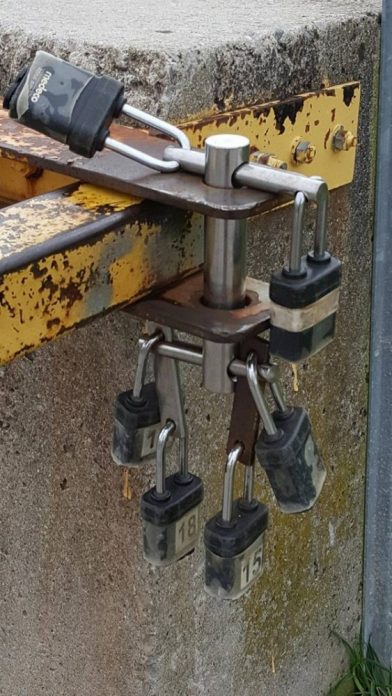
“Awkward” has a page entitled “15 People Are Wayyyyyy Too Overprotective”.  Photo 12 shows a gate locked with six locks. From my perspective, this is not being overprotective. Since at least three of the locks have numbers, I see this set of locks as part of a lock-out procedure. Each person has locked the area with his/her lock to ensure that no-one can enter/leave without them. Locking out is a good safety practice, not being overprotective. My problem is that anyone can remove all the locks by removing any one of the locks; a clear case of not thinking about thinking safety.

Don’t get me wrong, the premise is funny, and there is nothing wrong with having a good laugh. I am using Akward’s different interpretation of the photo to show that we make assumptions.

Assumptions are necessary. Without assumptions, we would need to start from scratch in everything we do. Our level of decision making would reduce to first principles. We would deplete our decision-making energy, halting all progress.

We must remember that the most significant assumption we make is that others know what we know. People are from different backgrounds and have different levels of exposure. Our experiences form our frame of reference for risk assessment. Not discussing a risk from the same frame of reference can lead to someone getting hurt. Assuming everyone has the same frame of reference is not a wise assumption.

We must test our assumptions.

Managers must always make sure that everyone is on the same safety page — especially those who are career starters.

By the way, photo 11 is not funny from a safety perspective, either.
work explained

SAFETY FIRST

Think about thinking about safety!


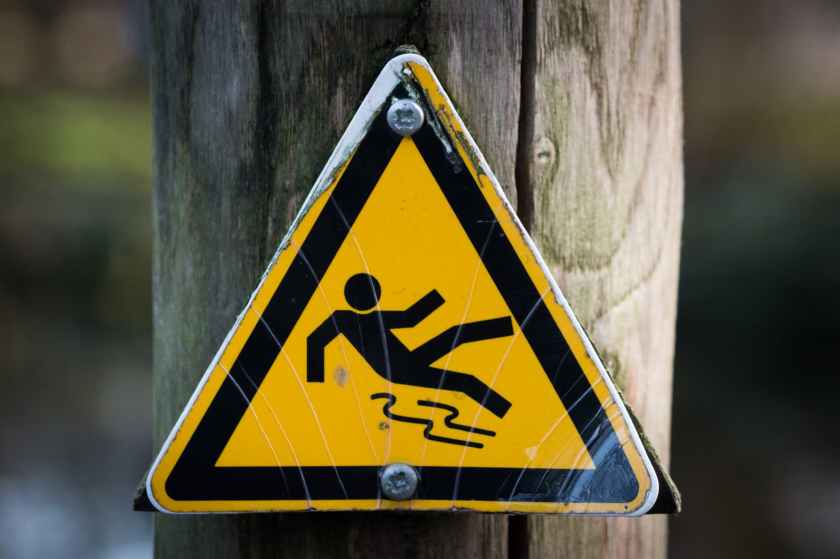
sign slippery wet caution
Photo by Skitterphoto on Pexels.com

Let’s start at the beginning. Safety First.

Yes, I will make a call to action then build up to a sale.

We must all think about safety.

We must think about thinking about safety.

When we instruct to instil safety, we must make sure that people can adhere to the instruction.

For example, “Use three points of contact when using stairs”. First, we must place the instruction on all stair handrails – easy. Second, the stair handrails must be close enough to each other so that a person can hold onto two handrails at a time. Not so easy, as one can see on most wide stairways. Third, the person using the stairs must have both hands free. WOW! How often does this happen? A logical conclusion is that we must provide escalators or lifts. A cheaper alternative is to have everyone use a shoulder bag to carry any objects.

Think about thinking about safety.

Another example will bring us closer to the sale.

Some workplaces have safety representatives. Safety representatives must complete regular safety inspections of the workplace. Two aspects of safety inspection forms/booklets spring to mind. First, the manager and the safety representative must be able to use the questionnaire. When all is well, the form must show that all is well. The form must identify an unsafe behaviour or activity for action.

Second, the inspection form must focus only on behaviours and conditions that are under the manager’s control. The questionnaire should not check compliance with construction regulations. For example, the safety representative does not need to know how many lights there should be but should report lights that don’t work.

Audits by qualified personnel/contractors must focus on infrastructure issues. The company should have addressed infrastructure issues during the building design phase.

Now the sale. I have developed forms that are easy to use and focus on controllable items only. You can order your copy of “I keep Record of Workplace Safety” from Amazon.com.Safety

History Repeats Itself

Let’s see if we can take a bit longer before we repeat history again. Let us learn.

#History #SchoolisforLearning

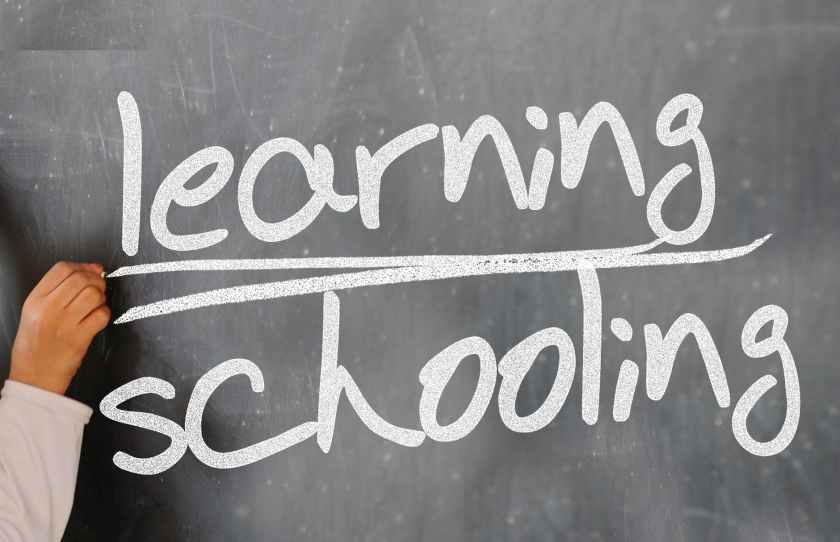
learning schooling text
Photo by Pixabay on Pexels.com

The above photo, by Pixabay, says one half of what I want you to hear.

The first half of what I am saying is “School is for learning.”

Peter F Drucker wrote in his book “Management” that organisations must focus on their goal. He uses the failure of the American schooling system as an example of an organisation losing its purpose. The American school system of the 1960s was used for social transformation instead of learning. Because of this loss of focus the American school system lagged the French school system.

The other half I want to say, others have said in various ways:

“History repeats itself.” – Various

“Those who fail to learn from history are doomed to repeat it.” Sir Winston Churchill

“The one who does not remember history is bound to live through it again” – George Santayana.


South Africa’s education system has failed to educate South Africa’s children. Additionally, the school system has been hijacked for various non-learning activities.

Learning in education must take priority. We have repeated history.

Social transformation is a slow process. Social transformation cannot be forced. Social transformation must be nurtured. Social transformation must be encouraged. Social transformation must be learnt. Social transformation must embed itself in society.

Let’s see if we can take a bit longer before we repeat history again. Let us learn.

What on Earth is Happening?

“What should have been done”, or “What should not have been done”, and

“What was done” and “What was not done”.

#Mistakes #LearnfromMistakes

pexels-photo-987585.jpeg
Photo by freestocks.org on Pexels.com

“Everything happens.” Even “IT happens.”


Eli Goldratt repeatedly said, and also put in print:

As a matter of fact I had to give up on the greatest pleasure of human beings, on the pleasure gained from bitching and moaning.”


Mistakes happen. You can bitch and moan, or learn from the experience. Mistakes cause problems if you are unlucky. My view, as a manager, is that I can tolerate a mistake the first time it happens, but not the second time.


We must take the time and learn from the mistake, no matter who might be responsible. The main aim of looking at the mistake is to prevent the mistake from happening again. I propose a method that helps you understand the mistakes.


Every action can be placed into one and only one of the following four categories (extended from a presentation by Dr Eli Goldratt, who focused on when things go Bad!):


Apologies to Shakespeare’s Hamlet

Should Do

Should Not Do

Did

Did what should have been done

GOOD! Did what should not have been done

Bad!

Did not do

Did not do what should have been done

Bad! Did not do what should not have been done

GOOD!

My suggestion to you is to analyse the mistake based on the two axes:

“What should have been done”, or “What should not have been done”, and

“What was done” and “What was not done”.

These four elements will distil the mistake into its components and will allow you to take action. If you take the right action, the mistake will not happen again. Happy days.

Crystal for a Christmas Tree – Science at work

The copper-iron and copper-silver interaction are examples of reduction and oxidation reactions.

#Christmas #Science #Chemistry

https://youtu.be/rplxY-THOQg


In the clip, a copper tree turns into a silver covered tree, which looks like a snow covered tree.


For those thinking of replicating the experiment, be prepared to fork out about $ 100.


You can do a much cheaper experiment (less than $ 1). Dip an iron nail into a copper sulphate solution. The iron nail will turn into a copper nail, almost immediately!


The copper-iron and copper-silver interaction are examples of reduction and oxidation reactions. Oxidation and reduction reactions make mirrors possible where silver is deposited on glass and copper is deposited on the silver layer.


Thanks for the link Alexander and Anderson.

Watching the Kettle Boil – Science

I used the time lapse facility to capture the image of the water heating process every five seconds and plotted the relationship. The relationship is linear, confirming that the 2000 W kettle element adds a constant amount of energy to the kettle and water every second.

#Science #ScienceatHome #FLIR #CatS61

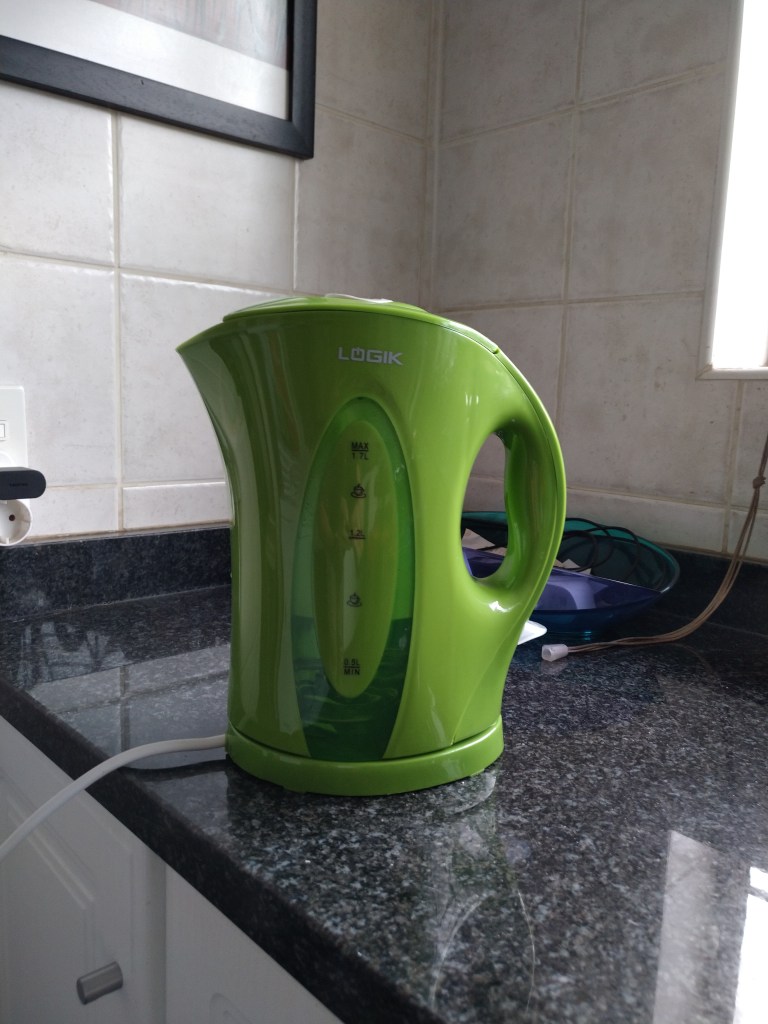
img_20190110_084639
Yes, a GREEN Kettle – of course.
I am the proud owner of a CatS61 smartphone, with a FLIR camera. The smartphone does what I need it to do.
 
Science is about observing nature and, as a friend of mine commented, saying “That’s odd”. I add, “How does that work?”
The people around me need me to have my morning coffee. On the odd occasion, my mind is awake before the coffee, though. I took out my Cat S61 FLIR camera and took photos of the kettle boiling, and yes it is a green kettle.
The photos show the false colour images; showing the relative temperatures of the objects in the room. As the water boils, the kettle’s body also heats up, and the images represent what is happening to the water inside the kettle. The images show the inferred temperature at the cross-hair point.
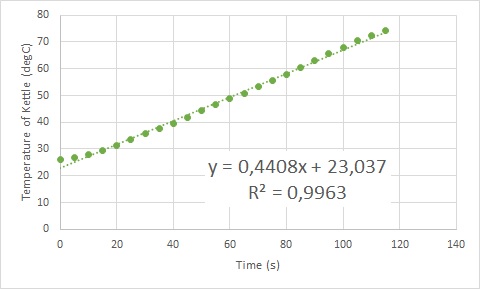
I used the time lapse facility to capture the image of the water heating process every five seconds and plotted the relationship. The relationship is linear, confirming that the 2000 W kettle element adds a constant amount of energy to the kettle and water every second.
plot of temperature
Proving that energy is constantly added to the kettle and water converting electrical energy into thermal energy

Hot on the Press – I Keep a Record of my Virtue – The Benjamin Franklin Method

If you would like to follow the Benjamin Franklin method I have a new notebook for you which will allow you to keep track of your progress to a more virtuous you.

#BenjaminFranklin #Virtues #BetterPerson

virtues

Benjamin Franklin, one of the most respected men in America’s history, decided to become a better man by choosing thirteen virtues and living in line with those virtues. He devised a plan to improve himself. His method is described in his autobiography, which is freely available thanks to the Gutenberg project.


Benjamin Franklin printed a book for himself to help him follow his progress in becoming more virtuous. He FOCUSED on one virtue at first. Every day, for a week, he focused on not doing anything that would be contrary to that virtue. For the other virtues, he would count the number of transgressions relative to those virtues. Once he mastered the one virtue, he would move on and then strive to keep his record clean for the mastered virtues plus one more virtue.


My rendition of Benjamin Franklin’s list of virtues is as follows,

  1. Self-restraint: Do not overeat nor drink until drunk.
  2. Silence: Only say something that will benefit others or yourself; avoid trifling conversation.
  3. Order: Everything has a place and everything in its place. Everything has its time and everything must be done in its time.
  4. Resolution: Do what you must and do what you said you would do.
  5. Frugality: Only spend money to benefit yourself or others – do not waste anything.
  6. Industry: Do not waste time – keep yourself busy with something useful and don’t do what is unnecessary.
  7. Sincerity: Do not be deceiving; think and speak innocently and justly.
  8. Justice: Do not harm anyone: either by doing something or not doing what you are supposed to do.
  9. Moderation: Avoid extremes – do not make others jealous.
  10. Cleanliness: Clean body, clothes and home.
  11. Tranquillity: Do not sweat the small things or things out of your control.
  12. Chastity
  13. Humility: Imitate Jesus and Socrates.

If you would like to follow the Benjamin Franklin method I have a new notebook for you which will allow you to keep track of your progress to a more virtuous you. I wish you luck in your journey and leave you with this prayer by Benjamin Franklin:

“O powerful Goodness! bountiful Father! merciful Guide! Increase in me that wisdom which discovers my truest interest. Strengthen my resolutions to perform what that wisdom dictates. Accept my kind offices to thy other children as the only return in my power for thy continual favours to me.”


The confusion over Blockchain Analysis by Eli Schragenheim

Please, let us #ThinkaboutTechnology.

via The confusion over Blockchain

#ThinkaboutTechnology


Eli Schragenheim currently writes an informative blog and his latest contribution focuses on an analysis of technology, in this case Blockchain.

Let’s start with Goldratt’s Six Questions on assessing the value of a new technology. This is a great tool for guiding us to raise the right questions and look for possible answers:

  1. What is the power of the new technology?

  2. What current limitation or barrier does the new technology eliminate or vastly reduce?

  3. What are the current usage rules, patterns and behaviors that bypass the limitation?

  4. What rules, patterns and behaviors need to be changed to get the benefits of the new technology?

  5. What is the application of the new technology that will enable the above change without causing resistance?

  6. How to build, capitalize and sustain the business?


Eli Schragenheim sums up the work of Dr Goldratt as described in his easy to read business novel Necessary but not Sufficient and his audio work Beyond the Goal: Theory of constraints. Dr Goldratt starts with a seemingly simple statement:


Technology can bring benefit if and only if it diminishes a limitation.

From this statement, like Eli Schragenheim in his blog, Dr Goldratt evaluates the technology that is available in nearly all medium and big enterprises: ERP.


I only have exposure to SAP as an ERP, and I am not impressed. Dr Goldratt predicted in his analysis that SAP-Hanna would be needed to clear up all the complexity of maintaining SAP. Since Dr Goldratt’s analysis was not based on any specific ERP system, the conclusions are valid for other system providers as well.


Managers are asked to test and buy new technologies nearly every day. Many of the past purchases caused more harm than good. The six evaluation questions above will enable managers to test the technology and prevent damage from coming to them and their organisation. Please, let us #ThinkaboutTechnology.

Follow through on your new year’s resolutions

animals birds dawn giraffe
Photo by Pixabay on Pexels.com

#NewYearsResolution


In the words of that admirable cat: “Take my advice I am not using it”. (For those who still don’t know who I am referring to: Garfield created by Jim Davis.)


I have goals. I do not have New Year’s Resolutions.


What should you have? Take a moment, think about your life and what you want to achieve. Done. Easy.


Your New Year’s Resolutions are exactly that, yours. So, sorry to disappoint you, I am not here to tell you how to achieve those lofty goals – only you will know how to achieve them. Thank you for visiting.


What I do want to say is: “Stick to your guns! And go for it!”

animal africa zoo lion
Photo by Pixabay on Pexels.com


I have a notebook for prayer and a notebook for reading the Bible in one year, should you be interested. As a Christian I have had prayer and Bible reading goals in the past. You must establish what God wants for you. When you do your own thing, you might succeed, but will be tired. If you do what God wants, you might succeed and will be better for attempting the goal.