One of the most used business analysis tools is the SWOT analysis. The SWOT analysis tool looks at the Strengths, Weaknesses, Opportunities and Threats to the current and future organisation. One then uses the resulting SWOT analysis to decide where to focus the organisation’s energy. For example, the opportunities identified might be so good that the organisation might pivot and produce a different product to the market, based on its untapped strengths.The SWOT analysis is not the four-dimensional graphic – it is the properly thought out paragraph that supports the recommendations for the organisation’s future
My book helps you think about the SWOT analysis and how to present the SWOT analysis for maximum effect. After all, any tool is only as useful as the hand that wields it. The pages also give the team leader and team guidance on doing the SWOT analysis in a group.
In my latest picture book (Molecules we Know) I show the molecular structure of everyday molecules, from the feel-good hormone dopamine to hydrochloric acid used in pools. I hope this book will awaken the love for chemistry in someone. At least the molecules will satisfy someone’s curiosity.
Workplace discipline is often confused with punishment. The confusion is unnecessary. Workplace discipline protects the Employer and Employee by correcting inappropriate behaviour. Workplace discipline prevents damage.
The Employer can categorise “Inappropriate behaviour” misconduct or incapacity.
The incapacity process involves three (or more) discussions. These discussions focus on the gaps between the current and desired performance of the Employee. The outcomes of the discussions are definite plans to close the gaps in performance. The programs might include more training and coaching. If the employer-employee relationship cannot continue, the Employer must present the evidence to a disciplinary enquiry. The chairperson of the disciplinary enquiry might then give sanction of no-fault dismissal.
For a severe offence (misconduct) the procedure often includes
the evidence hearing,
the verdict hearing
and the sanction hearing.
The term hearing above is interchangeable with Disciplinary Enquiry.
Workplace discipline must be progressive. The Employer must be sure that the Employee knows what the Employer expects. Often, employers don’t follow progressive discipline. The Employer then “jumps” to the worst punishment as the first step. Steps for progressive discipline can include the following:
Training
Coaching
Retraining
Verbal warning
Recorded warning
Written warning
Final written warning
Dismissal.
A disciplinary enquiry is usually only held when the Employer expects a final written warning or dismissal.
The chairperson of the hearing, Employee and Employer must determe whether the following is true:
Is there a rule?
Is the rule known to the Employee?
Is the rule reasonable?
Is the rule applied consistently?
Is the sanction fair?
My latest book (I Keep Record of Disciplinary Enquiries) guides the chairperson of the enquiry, Employee and Employer through the disciplinary enquiry. This procedure should prevent procedural unfairness. The other test is substantial fairness. The chairperson can ensure substantial fairness by applying his or her mind and making a desicion on the balance of probability.
Those who fail to plan, plan to fail – or so the poster in my primary school classroom said. Thus, Plan Weakly, is appropriate.
I have a book to help you keep track of your personal roles and the plans you make on for a week.
The pages of my book allow you to plan a week based on the roles you have identified for yourself and the goals you have set for yourself. The concepts expressed in those pages give life to the paradigms established by Stephen R Covey in his groundbreaking books:
The 7 habits of highly effective people
First Things First (with AR Merrill and RR Merrill)
Focus: Achieving your highest Priorities – The workshop to help you focus on and execute top priorities.
First, you write down your personal mission statement.
Second, you identify the roles you see yourself in. You also have the opportunity to plot out when you focus on each role.
Third, you identify goals for yourself in these roles.
Technology is not always the answer. One should use a tool as and when appropriate – horses for courses.
Many times we sit alone or within a group and we want to lay-out a project plan. We want to know whether we can or should do the project. Further, we also want to make sure we have a good base for more detailed planning with an advanced tool. The key is that we do not want to battle with the tool, we want to get the planning done.
One way of drawing up a first-pass project plan is to go old school and use pen and paper. A blank piece of paper is usually very daunting and can become chaotic.
Project planning involves deciding who needs to do what by when, and what comes first. Project management is much more, though.
In Gantt charts, you show “the what” in the first column and use several columns to show the when (from start to finish). The columns express different timeframes – depending on the extent of the project and the level of planning. Examples of timeframes are minutes, hours, days, months and years. You can plan the same project several times. You can plan at the level of months, then weeks. As the date of doing “the what” comes closer, you can plan hourly or even by the minute.
The tables in the book also allow you to show which tasks depend on each other.
Walter Pauk‘s book, “How to Study in College”[1], describes a note-taking method; known as “the Cornell note-taking system”. Scott Mautz[2] adds to this three-page-golden-nugget in a 650-page book of golden nuggets, by suggesting that one also notes down action items and emotions solicited.
My book provides you with space for the Cornell note-taking system components of
Making notes during the lecture,
Summarising the ideas on the page of notes,
Writing questions to help you remember the recorded notes, and
Commenting on the emotions these notes elicit.
The example below shows you what a note page on a “lecture on the Cornell method” looks like.
Review Date:
2020/01/28
Continue from the previous page?
No
Date of Lecture:
2020/01/28
Topic of Lecture:
Cornell Note-taking method
Review questions:
Name four methods of notetaking
What are the four columns of the Cornell Note Taking method used for?
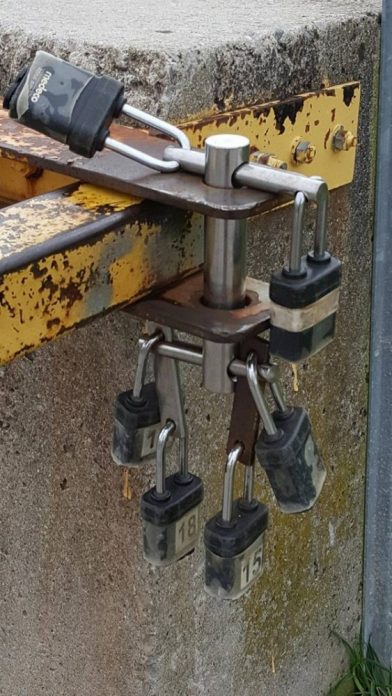
“Awkward” has a page entitled “15 People Are Wayyyyyy Too Overprotective”. Photo 12 shows a gate locked with six locks. From my perspective, this is not being overprotective. Since at least three of the locks have numbers, I see this set of locks as part of a lock-out procedure. Each person has locked the area with his/her lock to ensure that no-one can enter/leave without them. Locking out is a good safety practice, not being overprotective. My problem is that anyone can remove all the locks by removing any one of the locks; a clear case of not thinking about thinking safety.
Don’t get me wrong, the premise is funny, and there is nothing wrong with having a good laugh. I am using Akward’s different interpretation of the photo to show that we make assumptions.
Assumptions are necessary. Without assumptions, we would need to start from scratch in everything we do. Our level of decision making would reduce to first principles. We would deplete our decision-making energy, halting all progress.
We must remember that the most significant assumption we make is that others know what we know. People are from different backgrounds and have different levels of exposure. Our experiences form our frame of reference for risk assessment. Not discussing a risk from the same frame of reference can lead to someone getting hurt. Assuming everyone has the same frame of reference is not a wise assumption.
We must test our assumptions.
Managers must always make sure that everyone is on the same safety page — especially those who are career starters.
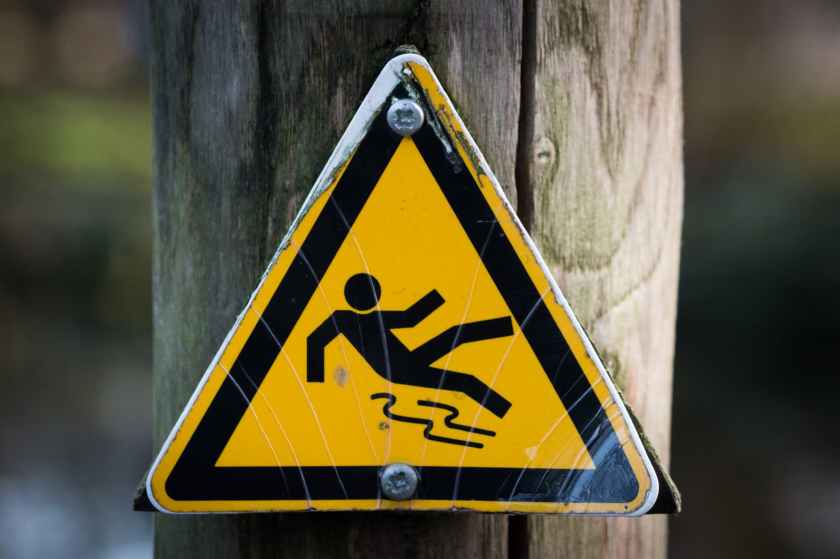
By the way, photo 11 is not funny from a safety perspective, either.
Yes, I will make a call to action then build up to a sale.
We must all think about safety.
We must think about thinking about safety.
When we instruct to instil safety, we must make sure that people can adhere to the instruction.
For example, “Use three points of contact when using stairs”. First, we must place the instruction on all stair handrails – easy. Second, the stair handrails must be close enough to each other so that a person can hold onto two handrails at a time. Not so easy, as one can see on most wide stairways. Third, the person using the stairs must have both hands free. WOW! How often does this happen? A logical conclusion is that we must provide escalators or lifts. A cheaper alternative is to have everyone use a shoulder bag to carry any objects.
Think about thinking about safety.
Another example will bring us closer to the sale.
Some workplaces have safety representatives. Safety representatives must complete regular safety inspections of the workplace. Two aspects of safety inspection forms/booklets spring to mind. First, the manager and the safety representative must be able to use the questionnaire. When all is well, the form must show that all is well. The form must identify an unsafe behaviour or activity for action.
Second, the inspection form must focus only on behaviours and conditions that are under the manager’s control. The questionnaire should not check compliance with construction regulations. For example, the safety representative does not need to know how many lights there should be but should report lights that don’t work.
Audits by qualified personnel/contractors must focus on infrastructure issues. The company should have addressed infrastructure issues during the building design phase.
Now the sale. I have developed forms that are easy to use and focus on controllable items only. You can order your copy of “I keep Record of Workplace Safety” from Amazon.com.
Eli Goldratt repeatedly said, and also put in print:
As a matter of fact I had to give up on the greatest pleasure of human beings, on the pleasure gained from bitching and moaning.”
Mistakes happen. You can bitch and moan, or learn from the experience. Mistakes cause problems if you are unlucky. My view, as a manager, is that I can tolerate a mistake the first time it happens, but not the second time.
We must take the time and learn from the mistake, no matter who might be responsible. The main aim of looking at the mistake is to prevent the mistake from happening again. I propose a method that helps you understand the mistakes.
Every action can be placed into one and only one of the following four categories (extended from a presentation by Dr Eli Goldratt, who focused on when things go Bad!):
Apologies to Shakespeare’s Hamlet
Should Do
Should Not Do
Did
Did what should have been done
GOOD!
Did what should not have been done
Bad!
Did not do
Did not do what should have been done
Bad!
Did not do what should not have been done
GOOD!
My suggestion to you is to analyse the mistake based on the two axes:
“What should have been done”, or “What should not have been done”, and
“What was done” and “What was not done”.
These four elements will distil the mistake into its components and will allow you to take action. If you take the right action, the mistake will not happen again. Happy days.
If you would like to follow the Benjamin Franklin method I have a new notebook for you which will allow you to keep track of your progress to a more virtuous you.
#BenjaminFranklin #Virtues #BetterPerson
Benjamin Franklin, one of the most respected men in America’s history, decided to become a better man by choosing thirteen virtues and living in line with those virtues. He devised a plan to improve himself. His method is described in his autobiography, which is freely available thanks to the Gutenberg project.
Benjamin Franklin printed a book for himself to help him follow his progress in becoming more virtuous. He FOCUSED on one virtue at first. Every day, for a week, he focused on not doing anything that would be contrary to that virtue. For the other virtues, he would count the number of transgressions relative to those virtues. Once he mastered the one virtue, he would move on and then strive to keep his record clean for the mastered virtues plus one more virtue.
My rendition of Benjamin Franklin’s list of virtues is as follows,
Self-restraint: Do not overeat nor drink until drunk.
Silence: Only say something that will benefit others or yourself; avoid trifling conversation.
Order: Everything has a place and everything in its place. Everything has its time and everything must be done in its time.
Resolution: Do what you must and do what you said you would do.
Frugality: Only spend money to benefit yourself or others – do not waste anything.
Industry: Do not waste time – keep yourself busy with something useful and don’t do what is unnecessary.
Sincerity: Do not be deceiving; think and speak innocently and justly.
Justice: Do not harm anyone: either by doing something or not doing what you are supposed to do.
Moderation: Avoid extremes – do not make others jealous.
Cleanliness: Clean body, clothes and home.
Tranquillity: Do not sweat the small things or things out of your control.
Chastity
Humility: Imitate Jesus and Socrates.
If you would like to follow the Benjamin Franklin method I have a new notebook for you which will allow you to keep track of your progress to a more virtuous you. I wish you luck in your journey and leave you with this prayer by Benjamin Franklin:
“O powerful Goodness! bountiful Father! merciful Guide! Increase in me that wisdom which discovers my truest interest. Strengthen my resolutions to perform what that wisdom dictates. Accept my kind offices to thy other children as the only return in my power for thy continual favours to me.”













 Green Octahedron Blogging